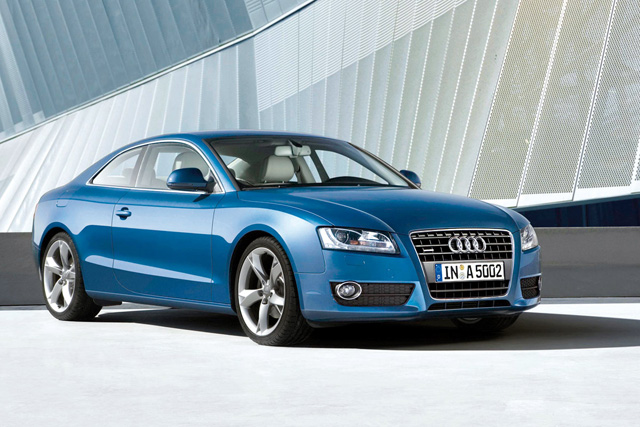
The A5 is the coupé variant of the 3rd generation A4 (B8) sedan and estate that was launched at the 2007 Frankfurt auto show. The A5 marks Audi's return to the mid-size coupé market since the (B3/B4) Audi 80-based Coupe model ended production in 1996 - the Mk 2 (B6/B7) A4 spawning a convertible variant but not a coupé.
The A5 debuts the new Audi MLP platform (Modular Longitudinal Platform) which is planned to underpin the next generation A4, A6 and A8 models. The platform is notable for its departure from Audi's trademark "overhung" engine mounting position over the front axle, in favour of the powertrain being located behind the front axle - in an effort to achieve a more even weight distribution (55/45) between the front and rear wheels.
The Audi A5 is the next model to be released following the second generation TT and R8 models. The A5 has adopted many elements of the 600 bhp (450 kW) bi-turbo V10 Nuvolari concept. The A5 will début with the 3.2-liter FSI V6 engine delivering 265 PS (261 hp/195 kW).
// Extracted from Wikipedia (see full text clicking here)//
Video:
lunes, 12 de noviembre de 2007
Audi A5


viernes, 13 de abril de 2007
Audi Avus Quattro

The Avus Quattro's engine was supposed to be a 6.0 L 60-valve 12-cylinder engine producing 509 hp, capable of accelerating the car from 0 to 60 mph in about 3 seconds and a top speed of 211 mph. The exact car shown at the Tokyo Motor Show, however, had a dummy made of carefully painted wood and plastic for an engine because at the time, such a powertrain was still in development; Audi-made W12 engines were not available to buyers until Audi presented its flagship A8 a few years later.
The Avus Quattro is now on display at Audi's museum in Ingolstadt, Germany.
// Extracted from Wikipedia (see full text clicking here)//
Video:
miércoles, 20 de diciembre de 2006
Walter da Silva presents Audi TT Design Development
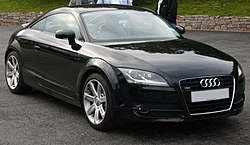
The production model (internal designation Typ 8N) was launched as a coupé in September 1998, followed by a roadster in August 1999. In August 2004, Audi announced that the next-generation TT will be made of aluminum and would go into production in 2007. A TT concept (the Audi Shooting Brake) was shown at the Tokyo Motor Show in 2005. This concept featured angular styling and a "shooting brake" 2-door hatchback body style.
The TT was nominated for the North American Car of the Year award for 2000. It was also on Car and Driver magazine's Ten Best list for 2000 and 2001.
// Extracted from Wikipedia (see full text clicking here)//
Video:
miércoles, 13 de diciembre de 2006
Audi R10

It was the first diesel to win either of those events. The Audi R10 project costs Audi €70 Million per year.[1] This is the most ambitious and the most expensive project ever undertaken by Audi Motorsport.
// Extracted from Wikipedia (see full text clicking here)//
Video:
domingo, 10 de diciembre de 2006
Audi Quattro

It is considered one of the most significant rally cars of all time, and was one of the first to take advantage of the then-recently changed rules which allowed the use of all-wheel-drive in competition racing. Many critics doubted the viability of all-wheel drive racers, thinking them to be too heavy and complex, yet the Quattro was an instant success, winning a rally on its first outing. It won competition after competition for the next two years.
The Audi Quattro shared many components and the core of its body style with the Audi Coupé, which was a member of the Audi 80 (B2 model) range.
// Extracted from Wikipedia (see full text clicking here)//
Video:
... and a tribute to 25 Years of Audi Quattro
Audi 90 Quattro IMSA-GTO

Audi ganó un total de ocho carreras. Un año después en Estados Unidos, Hans-Joachim Stuck celebra siete victorias IMSA-GTO con el Audi 90 quattro.
// Extracted from www.audi.com.gt (see full text clicking here)//
Video:
martes, 5 de diciembre de 2006
Audi R8
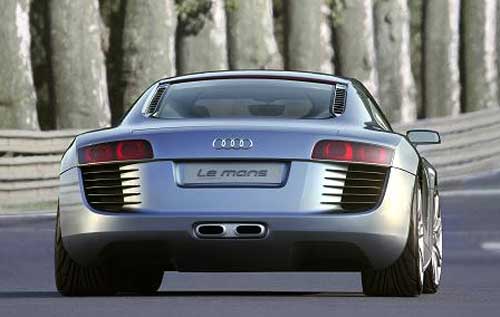
The R8 was officially launched at the Paris Auto Show on 30 September 2006. There is some confusion with the name which the car shares with the Le Mans winning R8 LMP. Originally, many thought the car would be called the R9 (as there is a gap in numbering left when Audi announced the R8's successor, the diesel-powered R10).
// Extracted from Wikipedia (see full text clicking here)//
Video:
domingo, 3 de diciembre de 2006
Pikes Peak Audi Quattro S1
The Audi Sport Quattro S1 was introduced in 1985 as an update to the Audi Sport Quattro. The car featured a inline 5-cylinder engine that displaced 2110 cc and produced 444 bhp.
The S1 proved to be an immediate success in the rally circuit, helping Walter Röhrl and Christian Geistdörfer win the 1985 San Remo Rally. A modified version of the S1, driven by Michèle Mouton, won the 1985 Pikes Peak International Hillclimb, setting a record time in the process.
// Extracted from Wikipedia (see full text clicking here)//
Video (1987 Peakes Peak edition):
Video (1985 Peakes Peak edition):