
Reviewing a pre-production car in 1967, Road & Track magazine summed up the 2000 GT (sic) as "one of the most exciting and enjoyable cars we've driven", and compared it favorably to the Porsche 911. Today, the car is seen as the first seriously collectible Japanese car, the first "Japanese Supercar", and examples change hands for fairly high prices.
The 2000GT made its most famous screen appearance in the 1967 James Bond movie You Only Live Twice. Although not nowadays quite as well known to the general public as later Japanese sports cars like the Nissan Z, the 2000GT is regarded by many collectors as possibly the first highly collectible Japanese car. As of 2004, good examples can reach very high auction prices (reaching even $200,000 at auctions).
// Extracted from Wikipedia (see full text clicking here)//
Video:
sábado, 8 de diciembre de 2007
Toyota 2000GT


domingo, 5 de agosto de 2007
Corvette StingRay

Styling changed subtly over the generation. Minor trim changes occurred through the 1972 model. In 1973, the Corvette dropped the front chrome bumpers for a urethane-compound "5 mph" bumper but kept the rear chrome bumpers. In 1974, the rear chrome bumpers became urethane as well, resulting in the first ever chrome-less production Corvette. 1975 saw the last year for the convertible, which did not return until 1986. In 1968 the "Sting Ray" name was not used, but returned in 1969 as a single word "Stingray" until 1976, the last year in which the name was used. 1978 saw a 25th "Silver Anniversary" edition, the introduction of a "fast back" glass rear window, and the highest production number until the C-5. In 1980, the Corvette got an integrated aerodynamic redesign that resulted in a significant reduction in drag.
// Extracted from Wikipedia (see full text clicking here)//
Video:
Opel GT (Original 1968)

The Opel GT was equipped with a base 1.1 L OHV straight-4 engine, which produced 67 hp (SAE) at 6000 rpm. However, most buyers chose an optional 1.9 L Cam-In-Head (CIH) engine, which produced 102 hp (SAE) at 5200 to 5400 rpm. The model run of the Opel GT was from 1968 to 1973.
The Opel GT used a steel unibody and a conventional front-engined, rear-wheel drive layout. The Cam-In-Head (CIH) engine was mounted far back in the chassis to improve weight distribution. Front suspension consisted of double A-arms and a transverse leaf spring. A live axle and coil springs were used in the rear. The power-assisted braking system used discs in the front, drums in the rear. Steering was unassisted. One unusual feature of the Opel GT was the operation of the pop-up headlights. They were manually operated, by way of a large lever along the center console next to the shifter.
During 1968 to 1973, a total of 103,463 cars were sold. The Opel GT can be seen in reruns of some episodes of the last season of Get Smart. Agent Maxwell Smart drove a GT in several episodes.
// Extracted from Wikipedia (see full text clicking here)//
Video:
Mercedes-Benz C111

The first version of the C111 was completed in 1969. It used a fiberglass body shell and had a three-rotor fuel injected Wankel engine mounted in the middle. The next C111 appeared in 1970. It used a four-rotor engine producing 370 hp (275 kW). The car could reportedly hit 180 mph (290 km/h).
The company decided not to adopt the Wankel engine and turned to Diesel experiments for the third C111. With its 230HP@ 4,400-4,600 5-speed manual straight-5 turbo-Diesel, the C111 broke nine diesel and gas speed records. With more aerodynamic bodywork that gave it an air drag coefficient of an incredible .191, the C111 eventually hit 200 mph (322 km/h) at Nardò in 1978, and averaged 14.7mpg@ 195.4 mi (316 km) over a 12 hour cruise. A later 500 hp (372 kW) 4.8 L twin KKK-turbocharged V8 version set another record, with an average lap-speed of 250.958 mph (403.78 km/h). It was achieved by Dr. Hans Leibold in 1 minute, 56.67 seconds on May 5, 1979.
Mercedes-Benz introduced a C112 at the Frankfurt Motor Show in 1991 as a production supercar. It used a 6.0 L V12 engine mounted in the middle. But after accepting 700 deposits, the company decided not to proceed with production.
// Extracted from Wikipedia (see full text clicking here)//
Video:
viernes, 27 de abril de 2007
Dodge Dart

Dodge also used the "Dart" name for a Ghia-built show car in the 1950s.
From 1965 to 1977 a Spanish version of the Dart was manufactured in the Barreiros Villaverde factory in Madrid. A total of 17589 units were manufactured in Spain. Darts were used as official representation cars for Spanish politicians during the 1960's and 1970's. Admiral Luis Carrero Blanco was killed on 20 December 1973 while travelling in his Dodge Dart 3700GT.
// Extracted from Wikipedia (see full text clicking here)//
Video:
martes, 3 de abril de 2007
Saab Sonett

In the 1950s Rolf Mellde suggested that Saab should make a small number of open-top two seater sport cars as racing regulations did not allow Saab to tune their cars as much as was needed to be competitive. Rolf Mellde designed the car himself and in utter secrecy built it in a barn in Åsaka outside Trollhättan. The total cost of the project was 75000 Kronor.
In the 1970s the Sonett design started to feel a bit outdated. In the USA, the motoring press railed against its appearance while extolling its handling characteristics. For their new design, to be called the Sonett III, Saab called in Sergio Coggiola.
Production was ended in 1974 due to stricter automobile emissions control in the USA. A total of 10,236 Saab 97 (Sonett II and III) were made.
// Extracted from Wikipedia (see full text clicking here)//
Video:
lunes, 2 de abril de 2007
BMW 507

The BMW 507 was the brainchild of BMW importer Max Hoffman, who in 1954 persuaded the BMW management to produce a roadster version of the BMW 502 that could compete with Jaguar and Mercedes-Benz sports cars. The 507 made its debut at the Frankfurt Auto Show in September 1955. Production began in November 1956. Intended to revive BMW's sporting image, the 507 instead took BMW to the edge of bankruptcy -- the company's losses for 1959 were DM 15 million. The company lost money on each 507 built, and production was terminated early in 1959. Only 252 were built, plus two prototypes.
It is believed 80% of 507s still survive, a tribute to the car's appeal, and good-condition or fully restored models fetch between $275,000-$300,000 at auction. The styling of the 507 later influenced the BMW Z8 and BMW Z3.
// Extracted from Wikipedia (see full text clicking here)//
Video:
domingo, 28 de enero de 2007
Alfa Romeo 33 Stradale

Built in an attempt by Alfa to make some of its racing technology available to the public, it was the most expensive automobile for sale to the public in 1968 at US$17,000.
The Stradale is believed to be the first production vehicle to feature dihedral doors, also known as butterfly doors. Other vehicles which feature doors of this nature include the Toyota Sera, McLaren F1, Ferrari Enzo and the Saleen S7. The Stradale also features windows which seamlessly curve upward into the 'roof' of the vehicle.
The car's performance was similarly unprecedented. The car took only six seconds to reach 60mph from a standing start.
// Extracted from Wikipedia (see full text clicking here)//
Video:
sábado, 27 de enero de 2007
Maserati Ghibli I

The Ghibli's steel body, renowned for its low, shark-shaped nose, was designed by Giorgetto Giugiaro. Giugiaro, who today heads his own company ItalDesign, worked at coachbuilder Ghia when he designed the Ghibli.
The car was powered by a front-placed quad-cam 330hp V8 engine. It had a 0-60 mph acceleration time of 6.8 seconds, had a top speed of 154 mph and could be operated by either a five-speed manual or three-speed automatic transmission.
The convertible Ghibli Spyder went into production in 1969. The Spyders were relatively rare, and the coupes outnumbered them almost ten to one. The slightly more powerful Ghibli SS (335 hp) was released in 1970. The Ghibli went out of production in 1973 and found a successor the following year with the Bertone-designed Khamsin.
// Extracted from Wikipedia (see full text clicking here)//
Video:
sábado, 20 de enero de 2007
Classic Rallye Trieste-Vienna 2006

The event consists of two classes: Historic Race and Historic Competition. In the first, participants drive full speed on race tracks and rallye spezial stages. This class was won by the team Constantin and Christian Kletzer on a Porsche 911. In Competition Class, where hundredths of seconds count, was won by Martin and Elisabeth Putzlager on a classic Jaguar E-Type.
Porsche 2.7RS, Ford GT40, Shelby Cobra, Alfa GTV, BMW's and other classic cars also take part in the 2006 edition of this great classic rally.
// Extracted from official website (see full text clicking here)//
Video:
1st Pyrénées Auto Classic

On departure day from Figueres in Catalonia, there were five Ferraris, three Jaguars, two Lagondas, the same number of Mercedes, Morgans and Alfa Romeos and a Porsche.
At the game of the twelve regularity races, Tom and Valérie Harris with their red Jaguar XK 120 roadster were the Pyrénées Auto Classic winners. The rallye finished in Biarritz.
// Extracted from official website (see full text clicking here)//
Video:
Pegaso Z-102 Spider

The Z-102 started life as two prototypes in 1951 as a coupe and a drophead. The coupe and convertible had dumpy steel bodies, and weight was an issue to the extent that Pegaso made the decision to revert to alloy for the coachwork. Coachbuilder Touring then 'beautified' the design, replacing the grille with a two-piece cross, lowering the car, repositioning the foglights, and simplifying various details to give it a clean profile, similar to the contemporary Aston Martin DB2 and the Lancia Aurelia, that was the most memorable and numerous of all Z-102 bodies.
The Z102 entered production with a 2.8 litre engine as used in the prototypes, though later there were variants with 3.1, 3.9, and 4.4 litre DOHC desmodromic 32-valve V8 360 hp (270 kW) engines with multiple carburetors or optional supercharger. Horsepower ranged from 175 to 360, and, transferred through a five-speed gearbox and gear-driven camshaft, the fastest could reach 160 mph, (256 km/h), exceeding Ferrari autos, thus making it the world's fastest production car at the time. The base car had an 120 mph (192 km/h) top speed.
However, the cars were heavy and brutish to drive and competition success was virtually nonexistent. Because the cars were built on a cost-no-object basis, this caused financial difficulty in the company. A simplified and cheaper version, the Z-103, was put into production, but to no avail, and the Z-102 was discontinued after 1958. Production figures range from 84-125, and out of these, only a handful of cabriolets were built.
// Extracted from Wikipedia (see full text clicking here)//
Video:
viernes, 29 de diciembre de 2006
La historia de la Hispano-Suiza

// Extracted from Wikipedia (see full text clicking here)//
Videos (6):
Mercedes F1 W196

Its delayed debut on the 1954 French Grand Prix brought the streamlined "Typ Monza" body for the high speed track at Reims-Gueux (and later Monza), and scored a 1-2 victory with Fangio and Karl Kling plus a fastest lap with youngster Hans Herrmann.
As the streamlined body was not situable for twistier tracks, causing a defeat at its second race at Silverstone, a proper open-wheel-version was introduced at the Nürburgring. Fangio, who had already won the first two GPs of 1954 with a Maserati, won this and the two following GPs, securing his 2nd World Championship.
In the 1955 Formula One season, the Mercedes managed to win all but one race, the 1955 Monaco Grand Prix, were Hans Herrmann crashed in practice, and the other 3 cars did not finish. For sportscar races of the 1955 World Sportscar Championship season, the Mercedes-Benz 300 SLR was derived from it.
After winning all world championships it competed in, Alfred Neubauer retired the cars at the end of the 1955 season.
// Extracted from Wikipedia (see full text clicking here)//
Video:
jueves, 28 de diciembre de 2006
Ferrari 250 GTO

The numerical part of its name denotes the displacement in cubic centimeters of each cylinder of the engine, whilst GTO stands for "Gran Turismo Omologata", Italian for "Grand Touring Homologated."
In 2004, Sports Car International named the 250 GTO number eight on the list of Top Sports Cars of the 1960s. Similarly, Motor Trend Classic named the 250 GTO as number one in their list of the "Greatest Ferraris of all time".
// Extracted from Wikipedia (see full text clicking here)//
Video:
... and static images:
Citroën DS (Tiburón)

The DS advanced the achievable standards in terms of ride quality, roadholding, handling, and braking in an automobile. Automotive journalists of the time often noted that competitors took decades to adapt to the higher standards it set. The smooth, aerodynamic body lines gave the car a futuristic appearance. While it looked very unusual in 1955, public tastes appear to have caught up with the DS in the post-Ford Taurus/Audi 100 era.
// Extracted from Wikipedia (see full text clicking here)//
Video:
Volvo P1800
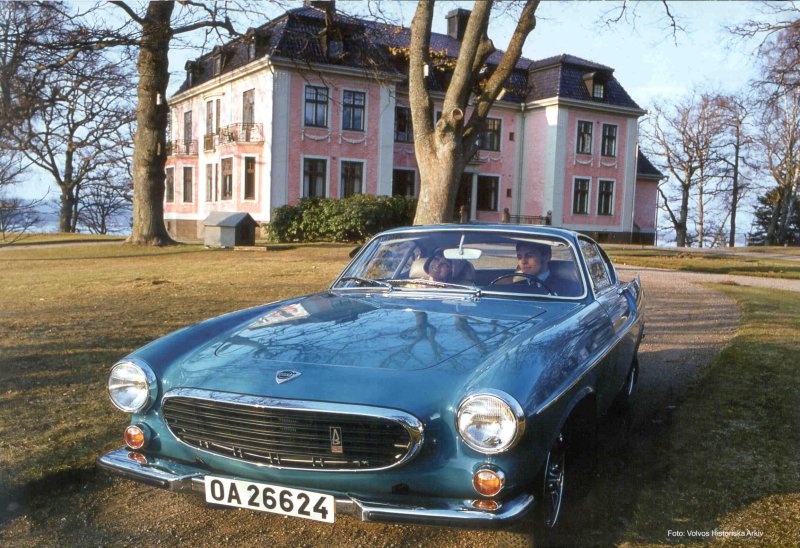
The man behind the project was an engineering consultant to Volvo, Helmer Petterson, who in the 1940s was responsible for the Volvo PV 444. The design work was done by Helmer's son Pelle Petterson, who worked at Pietro Frua at that time. The Italian Carrozzeria Pietro Frua design firm (then a recently acquired subsidiary of Ghia) built the first three prototypes, designated: P958-X1, P958-X2 and P958-X3.
In 1972 came the last model, the 1800ES, a hatchback or station wagon version with an all-glass tailgate; the engine was downgraded to 125bhp (92 kW) by reducing the compression ratio with a thicker head gasket (engine variant B20F); although maximum power was slightly down the engine was less "peaky" and the real-world performance was actually improved. For the last model year, 1973, only the 1800ES was produced. Total production of the 1800 line from 1961 through 1973 was 47,492 units. Production ended on June 27, 1973 although Volvo was in negotiations with Sergio Coggiola concerning a possible P1800ESC.
While Volvo never produced factory convertibles of the 1800, these were produced in the aftermarket. A Long Island, NY (USA) dealer, Volvoville, advertised a convertible version.
// Extracted from Wikipedia (see full text clicking here)//
Video:
miércoles, 20 de diciembre de 2006
Datsun 240 Z

Due to its relatively low price compared to other foreign sports cars of the time (Jaguar and Porsche), it became hugely popular in the U.S. and was the first major success for the Nissan Motor Corporation, which at the time sold cars in North America under the name Datsun. The Z is also credited as a catalyst for the current import performance parts industry.
In 2004, Sports Car International named this car number two on the list of Top Sports Cars of the 1970s.
// Extracted from Wikipedia (see full text clicking here)//
Video:
domingo, 17 de diciembre de 2006
Volkswagen Karmann Ghia

Over 445,000 Karmann Ghias were produced between 1955 and 1974.
// Extracted from Wikipedia (see full text clicking here)//
Video:
Alfa Romeo Story

Alfa Romeo has scored many prestigious victories in the following categories: Formula 1, Prototypes, Touring and Fast Touring. Private drivers also entered some rally competitions, with fine results.
// Extracted from Wikipedia (see full text clicking here)//
Video: