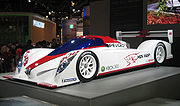
The 908 named is also shared with a Peugeot concept sedan, named the 908RC, which shares the diesel V12 engine from the 908 sportscar. The Peugeot 908 is not to be confused with another sportscar of the same name that raced in the 1960s, the Porsche 908.
// Extracted from Wikipedia (see full text clicking here)//
Video:
Mostrando entradas con la etiqueta Le Mans. Mostrar todas las entradas
Mostrando entradas con la etiqueta Le Mans. Mostrar todas las entradas
lunes, 12 de febrero de 2007
Peugeot 908 Le Mans


viernes, 15 de diciembre de 2006
Le Mans 1988

The 1988 event was the greatest race of the modern era with Porsche and Jaguar head to head for the full 24 Hours, and emotional scenes when Jaguar returned to the victory podium.
// Extracted from Wikipedia (see full text clicking here)//
Video:
miércoles, 6 de diciembre de 2006
24 Hours of Le Mans (1991)
So the FIA allowed the first 10 spaces on the grid to be reserved for the fastest qualifying 3.5 L cars from the World Sportscar Championship while the rest of the field was made up of Group C cars from previous year's championships and Le Mans races. In another twist, some teams which had 3.5 L cars, but entered previous year's championships with Group C cars, were allowed to enter their 'obsolete' but more reliable (and for Le Mans in 1991, quicker) Group C racers. So in the case of TWR Jaguar and Mercedes-Benz, their 3.5 L cars (the XJR-14 and C291 respectively) failed to qualify and instead they raced using their XJR-12 and C11 models respectively. Peugeot Sport on the other hand only had their 905 model to race, 1991 being their first season in sportscar racing, but with the absence of TWR Jaguar's far quicker XJR-14 the French marque had the honour of starting 1st and 2nd.
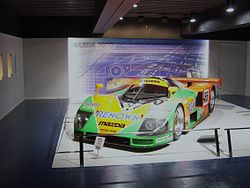
The very loud Mazda's 787B, powered with a rotary Model 26B Wankel engine, won in 1991. It was the first (and to date, only) Japanese car to ever win overall at Le Mans, as well as being the only non-piston engined car to achieve victory.
Mazda had been running at Le Mans since 1974, with a series of rotary-powered cars, starting with the RX-7. The company took 12th and a C Junior class win in 1983 with the 717C, but was less successful with the 727C and 737C. The company's performance had improved, though, with the 757 and 767/B claiming four consecutive GTP class wins from 1987 through 1990.
// Extracted from Wikipedia (see full text clicking here)//
Video:
24 Hours of Le Mans (1955)

This race saw the tragic death of 84 spectators and the injuring of over 100 more when Pierre Levegh's Mercedes-Benz 300 SLR was involved in an accident and flew into the crowd, killing the driver as well.
This accident, considered one of the worst in motorsports history, led to great changes in the measures taken to ensure the safety of drivers and spectators. Its fallout also led to many car manufacturers pulling out of motorsport, and even the outlawing of circuit racing in Switzerland.
// Extracted from Wikipedia (see full text clicking here)//
Video:
martes, 5 de diciembre de 2006
24 Hours of Le Mans (1999)

The race was overshadowed by a second Mercedes withdrawal from Le Mans, although no fatalities were recorded this time. Their new CLR racecars, while being very quick, suffered severe aerodynamic flaws causing accidents where the cars literally flew off the track and into the sky and cartwheeling through the air in three separate incidents, the most specatcular during the race which was captured on camera. This forced Mercedes to withdraw from the race.
Once again, it wasn't the fastest car that won, as the Toyota GT-Ones again hit accidents and mechanical problems, and the BMW team was able to secure a victory before their entry into Formula 1.
// Extracted from Wikipedia (see full text clicking here)//
Video:
Le Mans 2006

This race marked the first time a diesel-powered sports car, the Audi R10, has won Le Mans, and the second time a diesel-powered sports car has won a major international motorsports event, following the Audi R10 win at the 2006 12 Hours of Sebring.
Tom Kristensen could not extend his streak of 6 wins in a row, as his #7 car was less reliable than the winning #8 sister car. Yet, his #7 was fastest in practice and race. Rally-champion Sébastien Loeb scored a remarkable second place, possibly earning him a drive for the Peugeot 908 Diesel entry for 2007.
This race also marked the first time since the 1991 24 Hours of Le Mans that Porsche (or a Porsche powered prototype) did not win at least one class. A Panoz Esperante was successful in upsetting the contingent of Porsches in the GT2 class.
// Extracted from Wikipedia (see full text clicking here)//
Video:
Le Mans 73

John Wyer was back with two Cosworth-powered Gulf Mirage M6 roadsters. In 1000 km races the M6s had proven they were serious competitors and only a slight advantage allowed the Matras and Ferraris to dominate them. But had that time nobody would consider the a car powered Cosworth DFV, a flat plane V8 engine known for its destructive vibrations, as a favorite for Le Mans.
Ferrari sent the Arturo Merzario/Carlos Pace 312 out first as a rabbit. The Matra raced theur plan and let the Ferrari go. While the Matra were all running at the same speed, the Ferraris had diversified plans Carlos Reutemann and Tim Schenken were running among the Matra. While Jackie Ickx and Brian Redman were running with the slowest 3L cars the Lolas and the private Alfa Romeo.
Ferrari swapped the lead with Matra through the next four hours, but Pescarolo could repeat his victory with Gérard Larrousse as co-driver.
// Extracted from Wikipedia (see full text clicking here)//
Video:
Suscribirse a:
Entradas (Atom)