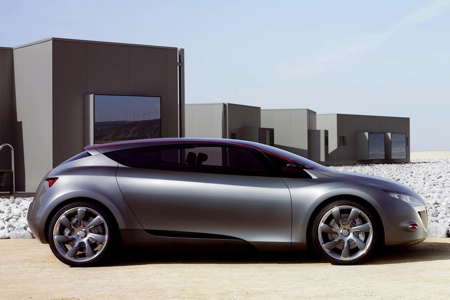
Like New Laguna, it points to an evolution towards more fluid, sportier styling from Renault. Mégane Coupé Concept targets drivers who are not only drawn by the notion of driving pleasure but who also seek to express their personality through their vehicle. Mégane Coupé Concept symbolizes Renault’s vision of what a genuine compact sports coupe should deliver, namely character and dynamism, two traits epitomized by the show car’s unprecedented door-opening kinematics.
// Extracted from automobilesreview.com (see full text clicking here)//
Video:
Mostrando entradas con la etiqueta Renault. Mostrar todas las entradas
Mostrando entradas con la etiqueta Renault. Mostrar todas las entradas
sábado, 22 de marzo de 2008
Renault Megane Coupe Concept


domingo, 4 de febrero de 2007
Renault Megane Trophy

The RS Trophy uses the considerably modified Renault Vel Satis 3.5 L V6 engine (which is a rebadged VQ35DE of Nissan VQ engine family) producing 330 bhp. The engine together with Sadev sequential gearbox is placed longitudally behind the cockpit.
Renault Sport Megane Trophy is not road legal, but can be bought for €120000. It is used for competition only.
// Extracted from Wikipedia (see full text clicking here)//
Video:
martes, 5 de diciembre de 2006
Renault Maxi 5 Turbo

The 5 Turbo featured a mid-mounted 1397cc Cléon turbocharged engine in a modified Renault 5 chassis. In standard form, the engine developed 160 hp (118 kW). Though it still resembled the standard Renault 5, and was badged a Renault 5, it had little technical similarity.
The first batch of 400 5 Turbos was produced to comply with Group 4 homologation. A second version, Turbo 2, was introduced using stock Renault 5 parts in replacement of many light alloy parts of the original 5 Turbo. The original 5 Turbo was in retrospect called "Turbo 1". The Turbo 2 was much cheaper but had nearly the same levels of performance.
All the racing derivatives were based on the Turbo 1. The factory pushed the engine output up to 180 hp (132 kW) for the Cévennes, 210 hp (154 kW) for the Tour de Corse, and possibly as much as 350 hp (257 kW) in the Maxi 5 Turbo. These kits featured stronger engine internals and more efficient intercoolers.
Driven by Jean Ragnotti the R5 Turbo won the Monte Carlo Rally on its first outing in the World Rally Championship. The 2WD R5 turbo soon faced the competition of new 4WD cars that proved faster on dirt. However, it remained among the fastest of its era on tarmac where it was highly successful.
In 2004, Sports Car International named the R5 Turbo number nine on the list of Top Sports Cars of the 1980s.
// Extracted from Wikipedia (see full text clicking here)//
Video:
lunes, 4 de diciembre de 2006
Renault Alpine A110

The A110 achieved most of its fame in the early 1970s as a victorious rally car. The car reached international fame during the 1970-1972 seasons competing in the newly created "International rally championship for makers", winning several events around Europe and became considered to be one of the strongest rally cars of its time. Among notable performances the car won the 1971 Monte-Carlo Rally with Swedish driver Ove Andersson.
Then in 1973, when the buy-out of Alpine by Renault was complete the International championship was replaced by a new "World rally championship for makers". Renault decided to compete in the World championship with the A110 and won in all races where the works team was entered except the Swedish Rally, making Alpine first rally World champion.
In 1974 the Lancia Stratos, the first car designed from scratch for Rally racing, was operational and homologated. At the same time, it was obvious that the A110 had reached the end of its development.
// Extracted from Wikipedia (see full text clicking here)//
Video:
Suscribirse a:
Entradas (Atom)