
Hornish won the race with the first final-lap pass for the lead in race history, by overtaking, on the final straightaway, rookie Marco Andretti, whose father Michael Andretti finished third. The margin of victory was 0.0635 seconds, the second-closest finish in the history of the 500.
For the first time, Honda was the sole engine supplier to the field. It is believed that for the first time in Indianapolis 500 history, that the race was run without a single engine problem.
// Extracted from Wikipedia (see full text clicking here)//
Video:
jueves, 14 de diciembre de 2006
Indianapolis 500 (2006)


Baja 500

Tradicionalmente comienza y termina en la ciudad-puerto de Ensenada. Tiene un recorrido de alrededor de 500 millas, que varia año con año de acuerdo al diseño del recorrido.
// Extracted from Wikipedia (see full text clicking here)//
Video:
miércoles, 13 de diciembre de 2006
12 Hours of Sebring (2006)
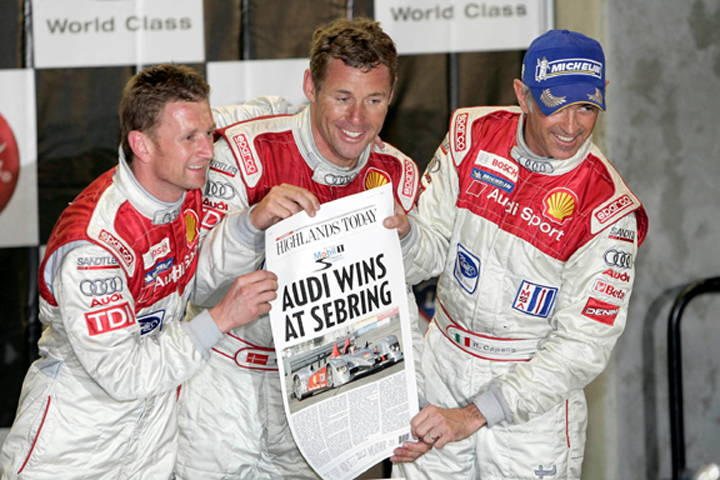
This race marked the first time that a diesel powered racing vehicle had won a major motorsports event, with Audi taking the victory in their new R10 sportscar, which was also the car's first race ever. However the win was not without problems, as one of the two Audi R10s suffered overheating problems and did not finish. This victory would be surpassed later with the diesel R10s winning the 24 Hours of Le Mans.
// Extracted from Wikipedia (see full text clicking here)//
Video:
miércoles, 6 de diciembre de 2006
IMSA GTP (80's)

Brian Redman was the first champion of the GTPs, driving a Lola T600. March also fielded prototypes, in which Al Holbert won the 1983 championship, and Randy Lanier a year later. 1984 also saw the introduction of the Porsche 962, which dominated the series from 1985 to 1987. Nissan then took control of the series in 1988, but faced challenges from Jaguar, Porsche, and Toyota throughout the proceeding three years. Toyota was quickest in 1992 and 1993, this being the end of GTP era.
There were many other manufacturers in the GTP class, such as URD, Spice, Intrepid or Gebhardt, and in the early 1990s, Mazda. Along with the GTP cars, the Camel Lights lightweight, low horsepower prototype category was introduced in 1985. Argo were the first Lights champions, followed by Spice. Well known were also Tiga, Royale, Alba, Fabcar, and Kudzu.
// Extracted from Wikipedia (see full text clicking here)//
Video:
martes, 5 de diciembre de 2006
Carrera Panamericana

After the Mexican section of the Panamerican Highway was completed in 1950, a multi-stage race across the country was established to celebrate this feat. It was contested by a handful of amateurs and several American factory teams.
Due to safety concerns (it was widely held by contemporaries to be the most dangerous race of any type in the world), the high speed race was cancelled after the 1955 Le Mans disaster. This was unavoidable given that cars of the period were of a high-speed, low-safety design, and drivers of a win-at-all-costs mentality.
The race was resurrected in 1988 by Eduardo León (2006 is the 18th retrospective year), and runs a 7-day, 2,000 mile route aping some of the original course. 80 cars compete in 10 classes, sorted regarding age and authenticity; virtually any car with a classic bodyshell is eligible. The bulk of entries are provided by 1950s and '60s American stock cars.
// Extracted from Wikipedia (see full text clicking here)//
Video (2006 edition):
Can-Am
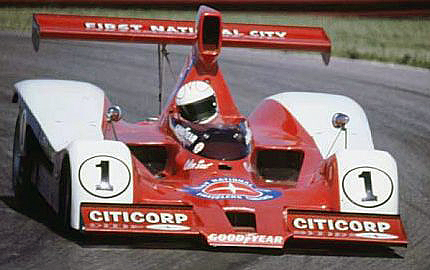
The Group 7 category was essentially a formula libre for sports cars; the regulations were minimal and permitted unlimited engine sizes (and allowed turbocharging and supercharging), virtually unrestricted aerodynamics, and were as close as any major international racing series ever got to anything goes. As long as the car had two seats and bodywork enclosing the wheels, and met basic safety standards, it was legal... Group 7 had arisen as a category for non-homologated sports car 'specials' in Europe and for a while in the 1960s Group 7 racing was popular in the United Kingdom as well as a class in hillclimb racing in Europe. Group 7 cars were designed more for short-distance sprints than for endurance racing. Some Group 7 cars were also built in Japan by Nissan and Toyota, but these did not compete outside their homeland (though some of the Can-Am competitors went over to race against them occasionally).
SCCA sports car racing was becoming more popular with European constructors and drivers, and the US Road Racing Championship for large-capacity sports racers eventually gave rise to the Group 7 Can-Am series. There was good prize and appearance money and plenty of trade backing; the series was lucrative for its competitors but resulted, by its end, in truly outrageous cars with well over 1000 horsepower (750 kW) (some teams claimed 1500 HP in qualifying trim), wings, active downforce generation, very light weight and unheard of speeds. Similar Group 7 cars ran in the European Interserie series, but this was much lower-key than the Can-Am.
A second generation of Can-Am followed, but this was a fundamentally different series based initially on converted Formula 5000 cars with closed-wheel bodies. There was also a 2L class based in Formula 2 chassis.
The Can-Am is mostly remembered as the last series to allow unlimited motor racing before it became definitely over in 1974.
// Extracted from Wikipedia (see full text clicking here)//
Video: