
Midway through 1985 the 037 was replaced in the Lancia factory rally car line up with the Delta S4 which featured 4WD and a unique turbocharged and supercharged motor.
// Extracted from Wikipedia (see full text clicking here)//
Video:
sábado, 12 de enero de 2008
Lancia Rally 037


miércoles, 6 de diciembre de 2006
Lancia Rallying - Tribute

By 1972, the Fulvia Coupé 1600 HF, nicknamed the ‘Fanalone’, had reached the end of its career but it still carried Sandro Munari to major successes (such as the Monte Carlo Rally), and brought Lancia victory in the FIA Cup, which was to become the World Rally Championship.
In the Stratos, Lancia had the winning card that brought it three consecutive world championship titles, in 1974, 1975 and 1976. Specially designed for rallies, and with only 500 models built (the requisite number for official recognition), the Stratos was a small saloon with a centrally-placed engine, designed by Bertone and fitted with the Dino Ferrari V6 engine.
In 1979 Lancia returned to the race track with the Lancia Beta Montecarlo Turbo. For two years, 1980 and 1981, it won the Constructors World Championship title in the endurance category. In 1983, Lancia claimed victory once again in the World Rally Championship with the Rally 037, created almost as a bet to challenge the supremacy of the German four-wheel drive cars. The Rally 037 was to be the last two-wheel drive car to win a World Rally Championship.
After the experience with the ultra-powerful Group B cars and the decision to limit rallies to cars with less than 300 bhp, Lancia shelved development of the Delta S4 and concentrated on the Delta HF 4WD with permanent four-wheel drive. That was in 1987. For the next six years, the Delta HF 4WD and the subsequent Delta HF ‘integrale’, ‘integrale 16v’ and ‘integrale 16v Evo’, dominated the world rally scene.
The list of successes included six consecutive Constructors World Championship titles, five World Drivers Championships, 46 outright victories in 66 world championship races, plus countless other successes in national races – a string of successes that would be difficult to equal and remains unbeaten to this day.
// Extracted from www.lancia.com (see full text clicking here)//
Video:
domingo, 3 de diciembre de 2006
Lancia Stratos
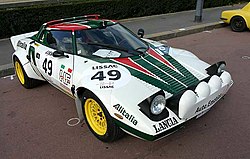
The bodywork was designed by Bertone and loosely based on a (Lancia Fulvia V4 powered) concept car called Lancia Stratos 0 first shown at the Turin Motor Show in 1970. The body was wedge-shaped, and unusually short and wide, providing maximum traction. However the final version of the Stratos was very different from the concept car. It had a distinctive crescent-shaped wrap-around windshield providing maximum forward visibility with almost no rear visibility (which was unnecessary for rallying anyway), and the engine was a mid-mounted 190 bhp (140 kW) 2418 cc Dino Ferrari V6.
The car won the 1974, 1975 and 1976 championships in the hands of Sandro Munari, and might have gone on to win more had not internal politics within the Fiat group placed rallying responsibility on the Fiat 131 Abarths. The final point to the Stratos's racing career at international level took place as late as 1981, at the Tour de Corse Automobile, a World championship event, with a victory of Bernard Darniche.
When the Fiat group favored the Fiat 131 for rallying Lancia also built two Group 5 turbocharged 'silhouette' Stratos for closed-track endurance racing. Theses cars failed against the Porsche 935s on closed tracks but proved successful in hybrid events. The last surviving car would win the Giro d'Italia event again before it was shipped to Japan to compete in the Fuji Speedway based Formula Silhouette series, which was never raced. The car would then be sold and reside in the Matsuda Collection before then being sold to the renowned collector of Stratoses, Christian Hrablek, also the founder-designer of Fenomenon.
// Extracted from Wikipedia (see full text clicking here)//
Video:
... and the Stratos development proces: