
The goal for the Porsche 9ff GT9 is at least 407 km/h. If successful it will be produced in a mini series of just 20 copies for 476.000 Euro each. One Arabian guy already placed an order, but only if they can break the 400 km/h limit.
The Porsche 9ff GT9 is based on the Porsche 911 GT3, but only two parts remained, all the others have been exchanged for a lot of carbon and even wood. In addition the Porsche 9ff GT9 was stretched by 30 centimers, the roof was lowered by 12 centimeters, otherwise it will take off by that speed.
// Extracted from The German Car Blog (see full text clicking here)//
Video:
Mostrando entradas con la etiqueta Porsche. Mostrar todas las entradas
Mostrando entradas con la etiqueta Porsche. Mostrar todas las entradas
jueves, 3 de enero de 2008
Porsche 9FF GT9


jueves, 14 de diciembre de 2006
Porsche 911
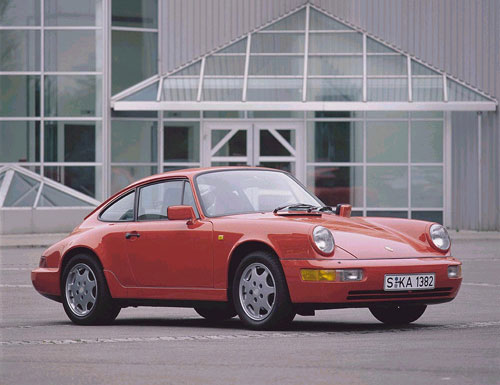
Since its inception the 911 has been modified, both by private teams and the factory itself, for racing, rallying and other types of automotive competition. It is often cited as the most successful competition car ever, especially when its variations are included, mainly the powerful 935.
In the international poll for the award of the world's most influential car of the twentieth century the 911 came fifth after the Ford Model T, the Mini, the Citroën DS and the Volkswagen Beetle. It is the most successful surviving application of the air (or water) cooled opposed rear engine layout pioneered by its original ancestor, the Volkswagen Beetle.
// Extracted from Wikipedia (see full text clicking here)//
Video:
miércoles, 13 de diciembre de 2006
Porsche 928

The 928 was sometimes called either shark or land shark, due both to its shark-like appearance and its ability to "eat up" large segments of road in very little time. Porsche's marketing slogan "It's about as fast as you can go without having to eat airline food" or "It is as fast as you can go without hiring a flight attendant" from the late 1980s where at one point it was the fastest production road-car in the world, having been recorded at 172mph on the salt flats in Utah in 1986 using an early 928 S4. [1] This particular car was originally white but was sprayed bright red for the record attempt to make it stand out more against the salt in marketing material like videos and posters.
// Extracted from Wikipedia (see full text clicking here)//
Video:
... and a 928 promotional footage:
Porsche Speedster 356

However, before the war designer Ferdinand Porsche also created the Type 64 as well as a mid-engine prototype called "Number 1", which has led to some debate as to the "first" Porsche automobile.
The 356 was created by Ferdinand "Ferry" Porsche (son of Dr. Ing. Ferdinand Porsche, founder of the company). Like its ancestor, the Volkswagen Beetle (which Ferdinand Porsche senior had designed), the 356 was a four-cylinder, air-cooled, rear-engined, rear-wheel-drive car. While the 356's body was an original design by Porsche employee Erwin Komenda, its mechanicals (including engine, suspension and chassis) were all derived from the Volkswagen. Early 356 prototypes were bodied in aluminum, but this proved impractical for production, and all subsequent 356's were steel-bodied.[3]
The first 356, debuted on June 8, 1948, used many Volkswagen parts for manufacturing economy. However, Porsche quickly re-engineered and refined the car with a focus on performance, so that by the late 50's few parts were shared in common between the two marques. Little noticed at its inception in 1948, by the early 1950s the 356 had gained some renown among enthusiasts on both sides of the Atlantic for its exceptional aerodynamics and handling, as well as excellent build quality. It was common for owners to race 356s as well as drive them on the street.
// Extracted from Wikipedia (see full text clicking here)//
Video:
... and a Speedster Tribute:
Porsche RS Spyder

Although the lighter P2 class cars do not have as much power as the larger P1 cars, the power to weight ratio between the two classes is very close. Combined with handling characterstics equal to the P1 cars, the RS Spyders are formidable opponents and have scored an overall race victory.
// Extracted from Wikipedia (see full text clicking here)//
Video:
Porsche 550 Spyder

Inspired by a small Porsche 356 Spyder which was created and raced by Walter Glöckler in 1951, the factory decided to build such a car, being its first designed specifically for use in auto racing.
The 550 became known as Spyder or RS, and gave Porsche its first overall win in a major sports car racing event, the 1956 Targa Florio.
Its successor from 1957 onwards, the Porsche 718, was even more successful, scoring points in Formula One as late as 1963.
// Extracted from Wikipedia (see full text clicking here)//
Video:
domingo, 10 de diciembre de 2006
Porsche 935

The 935 raced in various championships including the World Sportscar Championship, the IMSA championship and the Deutsche Rennsport Meisterschaft (DRM). Usually, no other make could challenge the Porsche 935, as each races at the time typically featured at least five of the same models due to the availability of customer models, racing became entertaining for the crowd at the expense of the drivers' frustrations, due to the unpredictable behaviour of the large turbocharger controlled by the mechanical fuel injection, causing a turbo lag and at a sudden a fireball spitting from the exhaust and giving out a large power output of typically 800bhp.
// Extracted from Wikipedia (see full text clicking here)//
Video:
miércoles, 6 de diciembre de 2006
Porsche GT3

It debuted on the 996 platform, replacing the similar 993-based 911 RS, which itself was simply the newest variant of a long line of RS models. In February of 2006, the 997 GT3 was revealed.
// Extracted from Wikipedia (see full text clicking here)//
Video:
martes, 5 de diciembre de 2006
Porsche GT1

Porsche debuted the 911 GT1 in 1995, announcing that it would compete at the 1996 24 Hours of Le Mans. In spite of its name, the car actually has very little in common with the 911, its floorpan was taken from the 956/962 Group C car. In addition, the GT1 featured a water cooled, twin-turbocharged and intercooled 3.2 L, four valve per cylinder flat-six in a mid-mounted position and making about 600 horsepower.
Regulations for the GT1 category stipulated that to be eligible, a total of 25 cars must be built for road use. Porsche developed a fully road-legal version of the GT1 and delivered one in early 1996 to the German government for compliance testing, which it passed. The engine had to be slightly de-tuned to meet European emissions laws, although its 544 PS (400 kW) and dry weight of 1,100 kg proved to be more than adequate; the vehicle could accelerate to 100 km/h (62 mph) from a standstill in 3.5 seconds on its way to a top speed of 310 km/h (193 mph).
Fly in LeMans 1999:
sábado, 2 de diciembre de 2006
Porsche Cayman S

The name "Cayman" is said to be an alternate spelling of caiman, a species of reptile closely related to the alligator, and has nothing to do with the Cayman Islands. Porsche has, in fact, donated to a Stuttgart Zoo's caiman exhibit, because of the shared namesakes between the animal and the automobile.
// Extracted from Wikipedia (see full text clicking here)//
Video:
Porsche 917

In the 1973 CanAm series, the turbocharged version Porsche 917/30 developed over 1100 bhp, and as much as 1500bhp in qualifying tune.
The 917 is one of the most iconographic sports racing cars of all time largely for its high speeds and high horsepower outputs and was even made into a movie star by Steve McQueen in his film Le Mans.
// Extracted from Wikipedia (see full text clicking here)//
Video:
Porsche Carrera GT

Porsche did however keep part of the project alive by using the 5.7L V10 from the prototype in a concept car shown at the 2000 Geneva Motor Show, mainly in an attempt to draw attention to their display. Surprising interest in the vehicle and an influx of revenue being provided by the Cayenne helped Porsche decide to make use of the car, and development started on a road-legal version that would be produced in small numbers at Porsche's new manufacturing facility in Leipzig. Porsche started a production run of Carrera GTs in 2004, shipping the units with an MSRP of $440,000 USD and a dealer invoice price of approximately $414,800 USD. In addition, the delivery charge could be as much as $15,000 USD. The first Carrera GT went on sale in the US on Jan 31, 2004.
// Extracted from Wikipedia (see full text clicking here)//
Video:
Suscribirse a:
Entradas (Atom)