
The Ferrari GTO was built to compete in the new Group B Race series and a minimum of 200 cars were required for homologation. However as the series was soon abandoned leaving just the Group B Rally championship, the 288 GTO never raced and all 272 cars built remained purely road cars.
The GTO was based on the mid-engined, rear wheel drive 308 GTB. With 400 hp, it was an impressive performer. Top speed was 189 mph (304 km/h), making it the first street-legal production car to reach 300 km/h.
Ferrari also built five 288 GTO Evoluzione models with more aggressive and aerodynamic body styling and increased power. The engine in the Evoluzione originally put out as much as 650 hp and top speed of 225 mph (362 km/h). Only three 288 GTO Evos are still in existence.
// Extracted from Wikipedia (see full text clicking here)//
Video:
lunes, 6 de julio de 2009
Ferrari GTO


domingo, 6 de enero de 2008
Ferrary Mythos

The prototype stored in Pininfarina style center at Cambiano (Italy).
// Extracted from Wikipedia (see full text clicking here)//
Video:
Not video available yet.
jueves, 28 de diciembre de 2006
Ferrari 250 GTO

The numerical part of its name denotes the displacement in cubic centimeters of each cylinder of the engine, whilst GTO stands for "Gran Turismo Omologata", Italian for "Grand Touring Homologated."
In 2004, Sports Car International named the 250 GTO number eight on the list of Top Sports Cars of the 1960s. Similarly, Motor Trend Classic named the 250 GTO as number one in their list of the "Greatest Ferraris of all time".
// Extracted from Wikipedia (see full text clicking here)//
Video:
... and static images:
domingo, 10 de diciembre de 2006
Ferrari FXX

The car uses some technology developed from the Enzo Ferrari and combines it with some all-new developments from Ferrari and some of the suppliers. However, the car is only a part of the overall program: people pay £1.3 million ($2 million usd) but are only allowed to drive the car on special track days approved by Ferrari and after they drive the car they have to brief Ferrari on the car's performance. Michael Schumacher was given one when he retired from Formula One racing at the end of 2006. Ferrari's sister company, Maserati has developed a similar car, the MC12 Corsa.
// Extracted from Wikipedia (see full text clicking here)//
Video:
Ferrari Enzo

The Enzo's V12 engine is the first of a new generation for Ferrari. It is based on the architecture of the V8 found in sister-company Maserati's Quattroporte, using the same basic architecture and 104 mm bore spacing. This design will replace the former architectures seen in V12 and V8 engines used in most other contemporary Ferraris. The 2005 F430 is the second Ferrari to get a version of this new powerplant.
In 2004, Sports Car International named the Enzo Ferrari number three on their list of Top Sports Cars of the 2000s.
Every four years Ferrari plans on coming out with a new version of the Enzo (not necessarily being called the Enzo). The new model of the Enzo comes equipped with a carbon fiber front bumper, and instead of having mirrors it has cameras(the views are displayed on a navigation system in the center console.
Motor Trend Classic named the Enzo as number four in their list of the ten "Greatest Ferraris of all time".
// Extracted from Wikipedia (see full text clicking here)//
Video:
sábado, 9 de diciembre de 2006
Ferrari History

After years of financial struggles, Enzo Ferrari sold the company's sports car division to the Fiat group in 1969 in order to help ensure continued financial backing for the foreseeable future. Enzo Ferrari himself retained control of the racing division until his death in 1988 at the age of 90.
Ferrari also has an internally managed merchandising line and distributes pens, perfume, high tech bicycles and laptop computers bearing the Ferrari brand.
// Extracted from Wikipedia (see full text clicking here)//
Videos (2):
... and a Ferrari Tribute:
martes, 5 de diciembre de 2006
Ferrari Testarossa

It should not be confused with the Ferrari TR "Testa Rossas" of the late 1950s and early 1960s. These were GT sports cars that ran in the World Sportscar Championship, including the 24 Hours of Le Mans.
// Extracted from Wikipedia (see full text clicking here)//
Video:
Ferrari 512BB
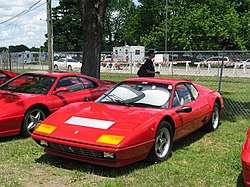
Production of the BB was a major step for Enzo Ferrari. He felt that a mid-engined road car would be too difficult for his buyers to handle, and it took many years for his engineers to convince him to adopt the layout. This attitude began to change as the marque lost its racing dominance in the late 1950s to mid-engined competitors. The mid-engined 4-, 6-, and 8-cylinder Dino racing cars was the result, and Ferrari later allowed for the production Dino road cars to use the layout as well.
The company also moved its V12 engines to the rear with its P and LM racing cars, but the Daytona was launched with its engine in front. It was not until 1971 that a mid-engined 12-cylinder road car would appear.
// Extracted from Wikipedia (see full text clicking here)//
Video:
Ferrari P 4/5

The car was an Enzo Ferrari but the owner James Glickenhaus preferred the styling of Ferrari's 1960s race cars, the P Series. The project cost Glickenhaus US$4 million but in an interview he said "I feel they gave me more than I expected". It was first presented to the public on August 18, 2006 at the Pebble Beach Concours d'Elégance.
// Extracted from Wikipedia (see full text clicking here)//
Video:
domingo, 3 de diciembre de 2006
Ferrari F50

Only 349 cars were made, one less than Ferrari estimated they could sell. This was, in the words of Ferrari spokesman Antonio Ghini, because "Ferraris are something cultural, a monument. They must be hard to find, so we will produce one less car than the market." The last F50 was produced in Maranello, Italy in July 1997.
The F50's engine predated the car: It was used in the Ferrari 333 SP for the American IMSA series in 1994 allowing it to become eligible for the stock engine WSC category.
// Extracted from Wikipedia (see full text clicking here)//
Video:
Ferrari Daytona

Unlike Lamborghini's new Miura, the Daytona was a traditional front-engined, rear-drive car. Customers were disappointed that Ferrari stuck with this layout unlike with the race cars, and the Daytona was replaced by the mid-engined 365 GTB Berlinetta Boxer in 1973. Today, the car represents the last of the great front engine Ferrari GTs before this layout was revived in the 1990s.
// Extracted from Wikipedia (see full text clicking here)//
Video:
Dino 246 GT

The Dino 246 was the first Ferrari model produced in high numbers. It is lauded by many for its intrinsic driving qualities and, for the time, its groundbreaking design. In 2004, Sports Car International placed the car at number six on its list of Top Sports Cars of the 1970s. Motor Trend Classic placed the 206/246 at number seven in their list of the 10 "Greatest Ferraris of all time".
// Extracted from Wikipedia (see full text clicking here)//
Video: